For all Akathists published on our site, click here. This Akathist was recently provided in English by Maxim, who kindly asks all Orthodox Christians to keep him in their prayers for his repentance.

Feast Day: April 8 and the Sunday of the Forefathers
Translator Note: The first person to canonize Samson the Judge as a Saint is Saint Apostle Paul! In his Epistle to Hebrews, chapter 11:
“And what shall I more say? for the time would fail me to tell of Gedeon, and of Barak, and of Samson, and of Jephthae; of David also, and Samuel, and of the prophets: Who through faith subdued kingdoms, wrought righteousness, obtained promises, stopped the mouths of lions. Quenched the violence of fire, escaped the edge of the sword, out of weakness were made strong, waxed valiant in fight, turned to flight the armies of the aliens. Women received their dead raised to life again: and others were tortured, not accepting deliverance; that they might obtain a better resurrection.” (KJV)
Kontakion 1
To thee, O Samson, chosen from the womb and set apart by the angel’s voice, we cry aloud in wonder: thou wast a living sign of God’s mercy upon barren Israel. As the Spirit rushed upon thee in the camp of Dan, so rush upon us now, that with strength divine we may sing:
Rejoice, Samson, Nazirite of God and breaker of bonds!
Ikos 1
Behold, the people of Israel languished under Philistine yoke, yet the Lord looked upon Manoah’s wife and said, “Thou shalt conceive and bear a son.” Therefore we marvel and proclaim:
Rejoice, fruit of a sterile womb made fertile by grace!
Rejoice, vow of the Nazirite sealed before thy birth!
Rejoice, razor that never touched thy head, type of unbroken obedience!
Rejoice, locks of power flowing like the seven streams of Eden!
Rejoice, for the angel ascended in the flame of the altar!
Rejoice, for thy mother was commanded to drink no wine nor strong drink!
Rejoice, thou who didst begin to deliver Israel from the hand of the Philistines!
Rejoice, Samson, Nazirite of God and breaker of bonds!
Kontakion 2
Seeing the young lion roaring against thee in the vineyards of Timnah, the Spirit of the Lord came mightily upon thee, and thou didst rend it as one tears a kid. From its carcass flowed honey, and thou didst feed thy parents, yet hid the riddle in thy heart. Wherefore we sing: Alleluia!
Ikos 2
At the wedding feast in Timnah thou didst speak a riddle born of divine wonder: “Out of the eater came something to eat; out of the strong came something sweet.” When the men of the city threatened thy bride, she wept before thee until the seventh day. Thus we honour thy patience and cry:
Rejoice, thou who didst slay the lion with naked hands!
Rejoice, thou who didst turn death into sweetness!
Rejoice, riddle of providence veiled in honey!
Rejoice, for thirty companions received linen garments and festal robes!
Rejoice, thou who didst ascend to Ashkelon and smote thirty Philistines!
Rejoice, fire of righteous wrath kindled by the Spirit!
Rejoice, for thy father-in-law gave thy wife to another!
Rejoice, Samson, Nazirite of God and breaker of bonds!
Kontakion 3
When thy anger was hot against the Philistines, thou didst catch three hundred foxes, turned tail to tail, and put firebrands between them. The blazing fields of standing grain, vineyards, and olive groves bore witness to thy vengeance. Beholding this, we cry: Alleluia!
Ikos 3
The men of Judah bound thee with two new ropes to deliver thee to the Philistines, yet at Lehi the Spirit of the Lord rushed upon thee, and the ropes became as flax touched by fire. With the jawbone of an ass thou didst slay a thousand men. Therefore we extol thee:
Rejoice, thou who didst turn captivity into victory!
Rejoice, thou who didst make the jawbone a sceptre of judgment!
Rejoice, heap upon heap—Ramath-lehi, the lifting up of the jawbone!
Rejoice, for the Philistines fell as stubble before the flame!
Rejoice, thou who didst cry, “With the jawbone of an ass, heaps upon heaps!”
Rejoice, for God clave the hollow place and water flowed—En-hakkore, the spring of the crier!
Rejoice, thou who didst judge Israel twenty years in the days of the Philistines!
Rejoice, Samson, Nazirite of God and breaker of bonds!
Kontakion 4
In the valley of Sorek thou didst love a woman named Delilah, and the lords of the Philistines promised her eleven hundred pieces of silver to entice thee. Three times thou didst deceive her, yet on the fourth thy soul was vexed to death. Wherefore, grieving, we sing: Alleluia!
Ikos 4
“Tell me wherein thy great strength lieth,” she pressed, and thou didst say, “If I be bound with seven fresh bowstrings…” Again, “with new ropes…” Again, “if thou weavest the seven locks of my head with the web…” But love betrayed thee, and thou didst reveal all. Thus we lament and praise:
Rejoice, thou whose strength was not in bowstrings nor ropes!
Rejoice, thou whose locks were woven with the pin of the loom!
Rejoice, for the Philistines shouted, “The gods have delivered Samson into our hand!”
Rejoice, thou whose eyes were put out and brought down to Gaza in fetters of bronze!
Rejoice, grinder in the prison house, type of humbled pride!
Rejoice, for thy hair began to grow again after it was shaven!
Rejoice, hidden mercy of God in the midst of judgment!
Rejoice, Samson, Nazirite of God and breaker of bonds!
Kontakion 5
On the day of the great sacrifice to Dagon, the Philistines brought thee out to make sport before three thousand men and women upon the roof. Between the pillars thou didst pray, “O Lord God, remember me and strengthen me only this once.” Wherefore, dying, we sing: Alleluia!
Ikos 5
“Let me die with the Philistines,” thou didst cry, and bowing thyself with all thy might, the house fell upon the lords and all the people. Thou slewest more at thy death than in thy life. Therefore we magnify thee:
Rejoice, thou who didst pull down the temple of Dagon!
Rejoice, thou who didst crush the serpent’s head with thy fall!
Rejoice, for the middle pillars bore up the house of idolatry!
Rejoice, for the roof crashed upon princes, lords, and people!
Rejoice, type of Christ who destroyed death by death!
Rejoice, for thy brethren came and buried thee in the tomb of Manoah thy father!
Rejoice, thou who didst judge Israel twenty years and rest in peace!
Rejoice, Samson, Nazirite of God and breaker of bonds!
Kontakion 6
O Samson, mighty in weakness, thou wast a parable of fallen man restored by grace. Though thou didst stumble, yet in thy final prayer thou wast heard. Teach us to cry with compunction: Alleluia!
Ikos 6
As the angel foretold, thou didst begin to save Israel from the hand of the Philistines, yet thy life was a mirror of human frailty. Wherefore we flee to thy intercession, crying:
Rejoice, thou who teachest us vigilance over the Nazirite vow of the soul!
Rejoice, thou who showest that strength is made perfect in weakness!
Rejoice, for the Spirit departs when the vow is broken!
Rejoice, for the Spirit returns when the hair grows in repentance!
Rejoice, thou who didst slay a lion—foreshadowing Christ’s victory over the roaring one!
Rejoice, thou who didst carry the gates of Gaza to the hill—type of Christ bearing the gates of Hades!
Rejoice, thou who didst die between the pillars—icon of the Cross between two thieves!
Rejoice, Samson, Nazirite of God and breaker of bonds!
Kontakion 7
Strange and awesome was thy birth, announced by fire and flame; stranger still thy death, crushing the house of the enemy. In both we see the hand of God, and sing: Alleluia!
Ikos 7
From the barren womb to the prison mill, from the jawbone to the pillars of Dagon, thy path was marked by wonders. Therefore we sinners fall before thee:
Rejoice, thou who wast set apart before thou wast born!
Rejoice, thou who didst drink from the hollow place in Lehi!
Rejoice, thou who didst carry the gates of Gaza upon thy shoulders!
Rejoice, thou who didst grind in blindness yet saw God in prayer!
Rejoice, thou whose final act shook the foundations of idolatry!
Rejoice, thou whose burial was between Zorah and Eshtaol—sign of peace after strife!
Rejoice, thou who art numbered among the judges and heroes of faith!
Rejoice, Samson, Nazirite of God and breaker of bonds!
Kontakion 8
All the host of heaven marvelled when the temple fell and Dagon lay headless before the ark in times past—now again when thou, a single man, didst overthrow a multitude. Wherefore we join the angels and sing: Alleluia!
Ikos 8
O Samson, thou wast a flame of zeal in a darkened age. Though thou didst fall, thou didst rise in prayer. Be thou our advocate before the throne of grace:
Rejoice, thou who teachest us to guard the senses!
Rejoice, thou who showest the peril of unholy alliances!
Rejoice, thou who didst turn sport into judgment!
Rejoice, thou who didst make the house of laughter a tomb!
Rejoice, thou whose death was thy greatest victory!
Rejoice, thou who art a sign of resurrection hope!
Rejoice, thou who prayest for us who are bound by sin!
Rejoice, Samson, Nazirite of God and breaker of bonds!
Kontakion 9
To save a sinful people, the Lord raised thee up as a judge and deliverer. Though thy life was storm-tossed, thy end was crowned with glory. Wherefore we sing: Alleluia!
Ikos 9
As Manoah prayed, “Let the man of God come again,” so we pray: let thy strength, O Samson, support us in the hour of temptation:
Rejoice, thou who didst begin and end with the Spirit of the Lord!
Rejoice, thou who didst carry the gates by night—type of Christ harrowing hell!
Rejoice, thou who didst slay a thousand with the weapon of humility!
Rejoice, thou whose blindness opened the eyes of faith!
Rejoice, thou who didst die that others might live in freedom!
Rejoice, thou whose tomb is a place of quiet after battle!
Rejoice, thou who art remembered when Israel cries unto God!
Rejoice, Samson, Nazirite of God and breaker of bonds!
Kontakion 10
No hymn can contain the mystery of thy life, O Samson, for in thee we see both the frailty of Adam and the power of the Spirit. Wherefore we fall silent and sing: Alleluia!
Ikos 10
From the lion to the pillars, from Timnah to Gaza, thy deeds proclaim the hidden ways of God. Therefore we cry:
Rejoice, thou who wast a Nazirite yet loved a Philistine woman!
Rejoice, thou who didst weave a riddle from a carcass!
Rejoice, thou who didst set fire to the tails of foxes!
Rejoice, thou who didst drink water from the jawbone’s hollow!
Rejoice, thou who didst carry the gates to the mountain before Hebron!
Rejoice, thou who didst bow with all thy might between the pillars!
Rejoice, thou who art a parable of grace abounding over sin!
Rejoice, Samson, Nazirite of God and breaker of bonds!
Kontakion 11
O holy Samson, as thou didst pray in thy blindness, “Strengthen me only this once,” so pray for us who are blinded by passions. Grant us tears of repentance, that with thee we may sing: Alleluia!
Ikos 11
In the book of Judges thou art written as one who began to deliver Israel. Complete thy work in us, O judge of old:
Rejoice, thou who teachest us to number our days!
Rejoice, thou who showest the folly of trusting in human strength!
Rejoice, thou whose hair grew again—sign of returning grace!
Rejoice, thou who didst make the house fall on the lords and on all the people!
Rejoice, thou whose death was more glorious than thy life!
Rejoice, thou who art a forerunner of the Stronger than the strong man!
Rejoice, thou who intercedest for the weak and fallen!
Rejoice, Samson, Nazirite of God and breaker of bonds!
Kontakion 12
Grace and truth shone through thy flawed life, O Samson. Thou didst sin, yet repentedst; thou didst fall, yet wast raised. Wherefore, we sing the mercy of God revealed in thee: Alleluia!
Ikos 12
Singing thy contest and thy victory, we fall down before the Lord who worketh mightily in the weak, and we cry to thee:
Rejoice, O Samson, last of the Judges!
Rejoice, first of the restored in spirit!
Rejoice, thou who didst begin the breaking of Philistine power!
Rejoice, thou who didst end in sacrificial glory!
Rejoice, thou whose story warneth and encourageth!
Rejoice, thou who prayest for us at the right hand of the Father!
Rejoice, O mighty deliverer of Israel, strength of God incarnate in human frailty!
Rejoice, Samson, Nazirite of God and breaker of bonds!
Kontakion 13
O most glorious Samson, Nazirite of God, who didst rend the lion, carry the gates, and pull down the temple of Dagon: accept this hymn of thy servants, and by thy prayers break the bonds of our sins, that with thee we may ever sing to God: Alleluia! Alleluia! Alleluia!
Repeat three times, then repeat Ikos 1 and Kontakion 1.
Ikos 1
Behold, the people of Israel languished under Philistine yoke, yet the Lord looked upon Manoah’s wife and said, “Thou shalt conceive and bear a son.” Therefore we marvel and proclaim:
Rejoice, fruit of a sterile womb made fertile by grace!
Rejoice, vow of the Nazirite sealed before thy birth!
Rejoice, razor that never touched thy head, type of unbroken obedience!
Rejoice, locks of power flowing like the seven streams of Eden!
Rejoice, for the angel ascended in the flame of the altar!
Rejoice, for thy mother was commanded to drink no wine nor strong drink!
Rejoice, thou who didst begin to deliver Israel from the hand of the Philistines!
Rejoice, Samson, Nazirite of God and breaker of bonds!
Kontakion 1
To thee, O Samson, chosen from the womb and set apart by the angel’s voice, we cry aloud in wonder: thou wast a living sign of God’s mercy upon barren Israel. As the Spirit rushed upon thee in the camp of Dan, so rush upon us now, that with strength divine we may sing:
Rejoice, Samson, Nazirite of God and breaker of bonds!
Prayer to the Holy Judge Samson
O Samson, chosen of God and mighty in battle, who from thy youth wast set apart by the angel’s word and filled with the Spirit of the Lord: thou didst rend the lion, smite the Philistines with the jawbone, carry the gates of Gaza, and in thy final hour pull down the house of Dagon upon the enemy. Though thou didst fall into temptation, yet in repentance thou wast heard, and thy death became victory. Pray for us, O holy one, who are entangled in the snares of the flesh and the wiles of the adversary. Strengthen the weak, enlighten the blind, and break the fetters of sin that bind us. Teach us to guard the Nazirite vow of our baptism, that neither wine of worldly pleasure nor razor of compromise touch the consecration of our souls. As thou didst cry out in the prison house and wast remembered, so remember us when we cry from the mill of affliction. And at the end, when we stand between the pillars of death and life, grant that we may bow with all our might toward the Kingdom, pulling down every idol and entering with thee into the rest of the saints. For thine is the intercession towards the Father and the Son and the Holy Spirit, now and ever, and unto the ages of ages. Amen.
Source: https://archive.org/details/akathist-to-saint-samson-the-righteous-judge-of-the-house-of-israel
 Samson destroying the pillars.
Samson’s story has also garnered commentary from a Christian perspective; the Epistle to the Hebrews praises him for his faith.[52] Ambrose, following the portrayal of Josephus and Pseudo-Philo,[53] represents Delilah as a Philistine prostitute,[53] and declares that “men should avoid marriage with those outside the faith, lest, instead of love of one’s spouse, there be treachery.”[53] Caesarius of Arles interpreted Samson’s death as prefiguring the crucifixion of Jesus,[53] remarking: “Notice here an image of the cross. Samson extends his hands spread out to the two columns as to the two beams of the cross.”[53] He also equates Delilah with Satan,[53] who tempted Christ.[53]
Following this trend, more recent Christian commentators have viewed Samson as a type of Jesus Christ, based on similarities between Samson’s story and the life of Jesus in the New Testament.[54] Samson’s and Jesus’ births were both foretold by angels,[54] who predicted that they would save their people.[54] Samson was born to a barren woman,[54] and Jesus was born of a virgin.[54] Samson defeated a lion; Jesus defeated Satan, whom the First Epistle of Peter describes as a “roaring lion looking for someone to devour”.[55] Samson’s betrayal by Delilah has also been compared to Jesus’ betrayal by Judas Iscariot; both Delilah and Judas were paid in pieces of silver for their respective deeds.[56] Ebenezer Cobham Brewer notes in his A Guide to Scripture History: The Old Testament that Samson was “blinded, insulted [and] enslaved” prior to his death, and that Jesus was “blindfolded, insulted, and treated as a slave” prior to his crucifixion.[57] Brewer also compares Samson’s death among “the wicked” with Christ being crucified between two thieves.[57]
Commemoration on the Sunday of the Holy Forefathers
Which falls between the 11th and 17th days of December
The Birth of Sampson
“So the woman went in and told her husband, saying, “A Man of God came to me, and His appearance was like the appearance of an Angel of God, very frightening. But I did not ask Him where He was from, and He did not tell me His name. And He said to me, ‘Behold, you are pregnant and shall bear a son. Now drink no wine or strong drink, and do not eat anything unclean, for the child shall be holy to God from the womb to the day of his death.”
~ Judges, Chapter 13
“Let us praise Adam, Abel, Seth and Enos, Enoch and Noah, Abraham, Isaac and Jacob, Moses, Job and Aaron, Eleazar and Joshua, Barak, Sampson and Jephthah, David and Solomon.”
“Let us all now celebrate the memory of the forefathers, hymning their life which was pleasing unto God, for Whose sake they have been magnified.”
~ Orthros Hymns, Sunday of the Holy Forefathers
“Sampson, the brave and mighty judge of Israel, was a type of Christ, who came to conquer sin and death through his own death and resurrection.”
~ St. Ambrose of Milan (337-397 AD), Exposition of the Gospel of Luke
“Sampson, born by the divine promise, had the Spirit accompanying him, for we read: “The Lord blessed him, and the Spirit of the Lord began to be with him in the camp.” (Judges 13:25) And so foreshadowing the future Mystery, he demanded a wife of the aliens, which, as it is written, his father and mother knew not of, because it was from the Lord. And rightly was he esteemed stronger than others, because the Spirit of the Lord guided him, under Whose guidance he alone put to flight the people of the aliens, and at another time inaccessible to the bite of the lion, he, unconquerable in his strength, tore him asunder with his hands. Would that he had been as careful to preserve grace, as strong to overcome the beast!”.
~ St. Ambrose of Milan (337-397 AD), On the Holy Spirit, Book 2.5
“The strength of Sampson was not his long hair, but his faith in God. He was a true Nazirite, set apart for God’s service, and he lived a life of self-denial and obedience to God’s commandments.”
~ St. John Chrysostom (347-407 AD), Homilies on Judges
“Sampson’s riddle about the lion and the honeycomb teaches us that even from the most bitter trials and sufferings, God can bring forth sweetness and joy.”
~ St. Bede the Venerable (673-735 AD), Commentary on the Book of Judges
“One of the greatest Judges of Israel was Sampson. By his very death Samson killed more enemies than he had during his life.”
~ Hieromartyr Daniel (Sysoev) of Moscow, from his book “The Law of God”
For more Orthodox commentary on Righteous Sampson see the following articles:
https://www.christianorthodox.net/samson-the-christlike-judge/
https://blogs.ancientfaith.com/nootherfoundation/samson-gods-hell-raiser/


Saint Ephrem the Syrian also identifies Samson as a type of Christ in his “Hymns on Paradise”
https://pbs.twimg.com/media/HJu3BGhWQAAZ1D5?format=png&name=small
Also in the Hymns on the Nativity
https://pbs.twimg.com/media/HJuyAKDWsAAC85D?format=png&name=small
As a bonus, Maximus the Confessor’s Questions and Doubts:
Though, what Prassas translates here as “of the true Nazarite (ascetic) of Christ” is more accurately translated by Larchet as “du vrai nazaréen, le Christ” (of the true Nazarite, Christ), so it’s again Samson as a type of Christ.
https://pbs.twimg.com/media/HJvu2E2XoAEbDwC?format=png&name=small
https://pbs.twimg.com/media/HJvu9YXXsAAB4-P?format=png&name=small
https://pbs.twimg.com/media/HJvvPO7X0AAejfT?format=png&name=small
Continuation
Last Photo:
I’m not quite sure why Fr. Stephen De Young takes such a hard stance on this issue.
Wonder no longer. Here is Fr. Stephen De Young on this topic in his own words, with references and explanations. Samson is a “type” of antichrist:
Link:
https://blogs.ancientfaith.com/wholecounsel/2019/04/11/samson-and-the-origins-of-monasticism/
Excerpt:
“Certain individuals online have used this blog post to attempt to create a controversy by claiming that Samson, despite having no entry on any Chalcedonian Orthodox calendar (he is listed on the Coptic calendar) is a saint. The perspective on Samson reflected in this blog post is based first and foremost on what the Holy Scriptures say about him. Beyond this, the comparison between Samson and St. John the Forerunner which sees him as a forerunner of the antichrist is drawn directly from St. Hippolytus of Rome (“On Christ and Antichrist,” 15ff). St. Ephraim the Syrian, in his Nisibene Hymns, lists among the contents of hell “the horrors: the limbs of the giants, Sampson’s huge corpse, the skeleton of cruel Goliath; there is Og, the son of the giants, too, who made a bed of iron, where he reclined.” One is, of course, free to disagree with the Holy Scriptures and the Fathers.”
People honored on the Sunday of the Holy Forefathers
Righteous Priest Eleazar
Righteous Barak, Judge of Israel
Righteous Jael
Righteous Gideon, Judge of Israel
Righteous Jephthah, Judge of Israel
Righteous Samson (Sampson), Judge of Israel
Prophet Elijah (Elias)
Prophet Elisha
Prophetess Huldah
Prophet Isaiah
Prophet Nehemiah
Prophet Habakkuk (Avakum)
Prophet Obadiah
Prophet Haggai
Prophet Zechariah
Prophet Ezekiel
Prophet Jeremiah
Prophet Jonah
Prophet Malachi
Prophet Micah (Micaiah)
Prophet Nahum
Prophet Zephaniah
Righteous Mary, mother of Saint Anne (Anna) and grandmother of the Theotokos
Source for this list?
Source of this list?
The Greek Archdiocese of America. Here’s the problem. Samson is listed by name in Hebrews in what is referred to as the “Faith Hall of Fame.” He is referred to by name leading up to the Nativity as a righteous forebearer of Christ in a church service. Just that much alone makes it difficult to argue he can’t have an Akathist, or that he did not die a saint. Opinions can vary, but who else gets specifically praised in the NT and remembered in a church service that we don’t consider a saint?
problem with Father Stephen DeYoung is that he is wrong and that he also butchers the plain reading of Hebrews 11 as well as the context of the Nisibene Hymns.
Here is the context for the Nisibene Hymns: “2. (Death.)— If You are God show Your power; and if You are man, feel our power. And if it is Adam that You seek, go away! Because of his transgressions he is shut up here; Cherubim and Seraphim await not, in his stead to pay his debt. There is none among them mortal, so as to give his life in his stead. Who can open the mouth of hell, and plunge and bring him up from her, who has swallowed him and keeps a hold on him, and that forever!
3. I am He who has conquered all the wise men; and lo! In the corners they are heaped for me in hell. Come, enter, son of Joseph, and see terrible things; the limbs of the giants, the mighty corpse of Samson, and the skeleton of the stubborn Goliath; Og, moreover, the son of the giants, who made for himself a bed of iron and lay thereon, from whence I hurled him and cast him down; that cedar I laid low to the gate of hell.” – Hymn 36
“1. There have come to me ransomers from among the saints, but none has plundered me like the Son of Mary. For lo! Elijah brought a dead man to life; and even though he himself escaped from my hands, yet had I consolation after him, for the dead man whom he quickened, I carried off from him. By Elisha son of Shaphat, I was beaten as with rods, for he brought two dead men to life. By one staff I in turn bore away both the prophet and the dead whom he had raised. R., Blessed is He Who cleft the tombs of Sheol by His voice!
(…)
12. I remember Samson that lion’s cub, who broke and gave me the pillars of Philistia; also that mighty man of valor Abner son of Ner, took for me that fleet wild roe, Asahel son of Zeruiah, and smote him and cast him on the ground. Benaiah in the holy temple slew Jacob, justly as it is written.— Because justice has restrained her sword, henceforth penitents shall rejoice in grace.
17. An honeycomb in the midst of the skeleton, Samson found — was it then a mystery? This Jesus has multiplied for us mysteries. Amid billows of mysteries have I fallen, which show me in parable the life of the dead, in all mysteries and in all types. Out of the eater came forth meat was Samson’s parable. But to me it has befallen contrariwise; for the eater has come forth to me out of the meat, for out of Adam lo! has come the Son of Adam Who has destroyed me.” – Hymn 39
Also the Fathers spoke positively about Samson and they saw Samson as saved. The Church Hymns (The Canon of Prayer to the Holy Forefathers) also address him and they venerate him.
‘“And what do I more say”—he says? “For the time would fail me to tell of Gideon, and of Barak, and of Samson, and of Jephthah, of David also and Samuel, and of the prophets.”
Some find fault with Paul, because he puts Barak, and Samson, and Jephthah in these places.
What do you say? After having introduced the harlot, shall he not introduce these? For do not tell me of the rest of their life, but only whether they did not believe and shine in Faith.’
–St. John (Chrysostom), Sermon 27 on Hebrews
https://www.youtube.com/watch?v=lYc9SiPrII4
I’d also say you should watch this video.
“On the other hand, the Patriarch Abraham received the crown, not because he suffered death, but because he was faithful unto God; and the other Saints, of whom Paul speaks , Gideon, Barak, Samson, Jephtha, David and Samuel, and the rest, were not made perfect by the shedding of their blood, but by faith they were justified; and to this day they are the objects of our admiration, as being ready even to suffer death for piety towards the Lord. ” – Saint Athanasius the Great, Ad Episcopus Aegypti et Libyae, Chapter 21
Samson’s story has also garnered commentary from a Christian perspective; the Epistle to the Hebrews praises him for his faith.[52] Ambrose, following the portrayal of Josephus and Pseudo-Philo,[53] represents Delilah as a Philistine prostitute,[53] and declares that “men should avoid marriage with those outside the faith, lest, instead of love of one’s spouse, there be treachery.”[53] Caesarius of Arles interpreted Samson’s death as prefiguring the crucifixion of Jesus,[53] remarking: “Notice here an image of the cross. Samson extends his hands spread out to the two columns as to the two beams of the cross.”[53] He also equates Delilah with Satan,[53] who tempted Christ.[53]
And the problem with you is that you are appealing to non-Orthodox sources. The video link you post in your comment to someone earning money as an online amateur theologion is not credible. Most of your other links in your comment direct readers to a Roman Catholic site or to Wikipedia. “Righteous Samson” is not the same as Saint Samson.
“You are appealing to Non-Orthodox sources”.
LOL!
Are Saint John Chrysostom, Saint Athanasius the Great, Saint Caesarius of Arles (maybe you should read his life before you talk), Saint Ephrem the Syrian, Saint Jerome, Saint Augustine of Hippo, Saint Ambrose of Milan, Saint Aphrahat the Persian and the Liturgical Texts (Texts Chanted by the Priests during the Services or the Liturgy by the way) Non-Orthodox Sources?
Samson has never been canonized and that is a photo shopped icon of St. John
He has been canonized. Fr. DeYoung is deeply wrong on this issue. And if you really want some other icons, maybe more fitting of Saint Samson, I can grant you that: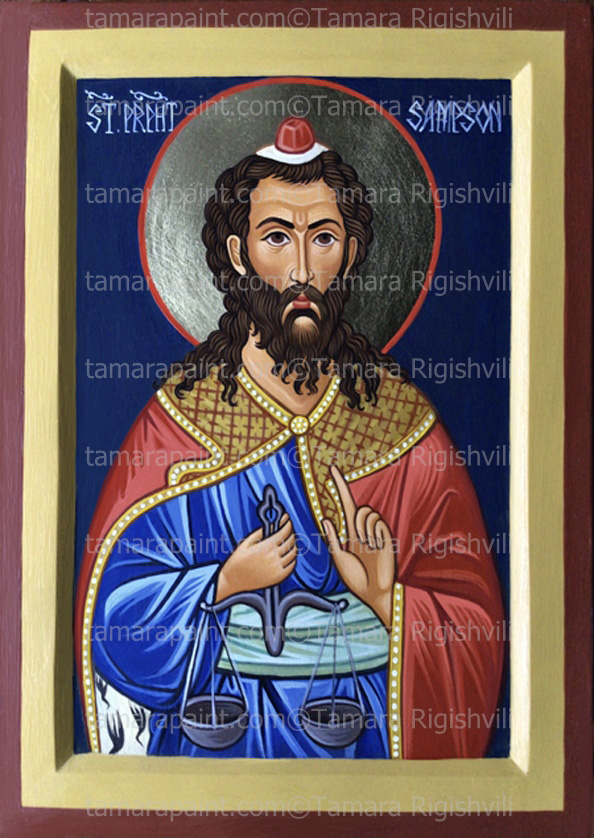
https://tamarapaint.com/icons6.html
In the future I’ll also translate from Romanian the Canon of Prayer to the Holy Forefathers because in that text Samson is mentioned right next to Adam and Enoch and is venerated.
Samson is also listed in Hebrews 11.
Yep, that’s the sole reason why he was recognized as a Saint by the Church! Nobody in the Church doubted his Sainthood till recently!
Samson has relics, is in our hymnography & iconography, praised in the NT, praised by the saints (attached is an excerpt from St. Agobard of Lyon), & is commemorated as a saint on the Sunday of the Holy Forefathers (see hymnography)
https://pbs.twimg.com/media/HDtaQOzaUAIw6pk?format=jpg&name=medium
https://pbs.twimg.com/media/HDtaaVIaUAImtfE?format=jpg&name=medium
Icon and relic of Samson, labeled as “Saint Samson the Strong,” housed at the Bagrati Cathedral in Georgia.
The bones of Samson were recovered from his tomb, likely during the Crusades, and made their way to Georgia.
https://pbs.twimg.com/media/GF1yqf7acAAx252?format=jpg&name=large
https://pbs.twimg.com/media/GF1yrUWa4AA-6kX?format=jpg&name=large
https://pbs.twimg.com/media/GF1yr5baUAAVyLh?format=jpg&name=large
I don’t know how you concluded that based on what I posted, a “local saint” isn’t commemorated universally in every jurisdiction’s hymnography. Did you open the link I posted? It goes to a respected Russian calendar, which lists him among the Holy Forefathers.
https://pbs.twimg.com/media/HDti5OZboAAC9R1?format=png&name=medium
There are actually quite a few, though hard to come by online. A good example are the iconographic scenes depicted on the Vatopedi Octateuch (ca. 1270–1300), which notably depict a halo’d Samson. Here’s also a modern icon.
https://pbs.twimg.com/media/HDvICimboAA-3mF?format=jpg&name=medium
https://pbs.twimg.com/media/HDvIEyzbcAAMfI_?format=png&name=900×900
https://pbs.twimg.com/media/HDvIGfebAAAFVV1?format=jpg&name=medium
Icon of Judge Samson from the iconostasis of the Saints Peter and Paul Cathedral in St. Petersburg (1727-1728):
https://pbs.twimg.com/media/HEMbgJuaIAARJwN?format=jpg&name=large
Blessed Haymo of Halberstadt (+853) on how the stone at Christ’s tomb represents the burden of original sin and how Samson the Judge typifies Christ:
https://pbs.twimg.com/media/G9WoOnkbAAANCkc?format=png&name=900×900
(Patrologia Latina Vol. 118, pgs. 450-451)
In ‘An Apology for the Sons of Louis the Pious Against Their Father’, St. Agobard of Lyon uses the example of St. Samson, who despite losing his power and being deceived by a woman, still gained eternal life, in order to inspire Emperor Saint Louis the Pious to repentance.
https://pbs.twimg.com/media/G1zWLMQaEAA7ACX?format=jpg&name=medium
“Samson gave himself time to be bound, laughing in his heart at his enemies. But then, filled with the Spirit of the Lord, he broke the bonds & struck down his enemies. So the Lord let Himself be bound by death, but then breaking the bonds of death, He broke the gates of hades.”
-1938 Paschal Message of St. John Maximovitch
https://www.mystagogyresourcecenter.com/2023/04/1938-paschal-message-of-st-john.html#more
“Saint” Samson??
I dont recall him being venerated
He is venerated on the Sunday of the Forefathers.
Translated from what? The “source” is just a link to archive.org with the same text and also no indication of the actual source of this text.