Daniel Lee (@siabaaLee) Texas native, disabled U.S. Army veteran (SGT, 35L Counterintelligence Special Agent, 2004–2012 with Iraq deployments), BS European History (Cum Laude), and Orthodox catechumen  . After his time with the 504th, 500th Military Intelligence Brigades and USARPAC, Daniel has been building as the Texan Spy Historian: channeling CI pattern recognition, source work instincts, and a fusionist lens (liberty + moral order/faith) into analysis and storytelling. Find more about Daniel on X. Visit his author page to read more from Daniel. Explore the Romanian Orthodox Heritage page for Akathists and more information about Romanian Martyrs under communist oppression.
Growing up as a boy in southeast Texas, I spent hours reading about the world behind the Iron Curtain. Accounts of prison camps, forced confessions, and the systematic breaking of people left me with one recurring question:
How could human beings become so twisted that they would design entire systems to destroy the soul?
That question did not stay abstract. It followed me into adulthood and played a part in my decision to serve in the Army as a counterintelligence special agent. I wanted to face evil where it existed rather than only read about it from afar. Years later, after deployments, after wrestling with the moral injuries that come from that work, and after beginning to see the same ideological currents at work among people in my own country, the question has changed. I no longer wonder how such evil takes root. I recognize the patterns when they appear. What follows is a reflection on that shift in understanding, drawn from history, from personal experience, and from the faith that has helped me make sense of both.
The Historical Pattern of Soul Destruction
The stories that disturbed me most as a boy are like this one that surfaced for me recently; on places like the Pitești re-education camp in Romania. There, under the early Communist regime, young prisoners, many of them students and Christians, were subjected to a deliberate program meant to remake them. The process started with raw terror. Prisoners watched others being killed or tortured to break their will. Then came the unmasking. Under torture they were forced to declare that their belief in God was a lie, that their love for their parents and their country was a lie, that everything they held sacred was nothing but bourgeois deception. After that, they were made to denounce friends and family. The final step required them to prove their re-education by taking part in the torture of new arrivals.
Father George Calciu, who survived twenty-one years in those prisons and later became a priest and outspoken dissident, described it plainly. The goal was to destroy every principle and every feeling so that only loyalty to the regime remained. This was not simple cruelty. It was a deliberate attempt to unmake the person in the image of God and replace that image with something engineered by the state.
 The Most Holy Birthgiver of God visiting the sick in the Romanian Prison of Târgu-Ocna
Pitești did not spring up from nowhere. The groundwork had already been laid by forerunners of terror. Lenin established the premise, in both theory and practice, that entire classes of people could be legitimately destroyed for the sake of the revolution, and the Cheka he founded in 1917 gave that premise an institutional home. Trotsky, who helped build the machinery of the Red Terror, before he himself became one of its casualties, argued that any means were justified once the end was declared historically necessary. Stalin systematized what Lenin and Trotsky had begun, engineering the Holodomor and filling the Gulag with millions whose only offense was insufficient devotion to the collective. Mao carried the same logic into China, first through the executions of land reform and later through the Cultural Revolution, in which children were pressed to denounce their own parents, sometimes with fatal consequences. Pitești was not an aberration within that history. It was the same method, even if applied with unusual precision: individual conscience stands in the way of the ideological project; it must be broken and remade.
At the same time that these architects were building their systems, many Western intellectuals and academics, who shared Marxist sympathies, chose not to see them clearly, or chose to explain them away. Walter Duranty, the New York Times correspondent whose reporting from Moscow won a Pulitzer Prize, denied the famine Stalin was engineering in Ukraine even as it killed millions. Sidney and Beatrice Webb, among Britain’s most influential socialist thinkers, returned from a tour of the Soviet Union to publish an admiring account of Stalin’s system, while the purges were already underway. Decades later the same courtesy was extended to Mao. The journalist Edgar Snow, whose privileged access to Mao gave his reporting outsized influence in the West, described the famine and terror of the Great Leap Forward and the Cultural Revolution in terms that minimized their human cost. Eugene Genovese, a historian who had belonged to the Communist Party as a teenager and remained a defender of the Soviet project for most of his life, broke with that habit in 1994. Writing in the left-wing journal Dissent under the title “The Question,” he turned on his former comrades and colleagues and asked what they had known about the crimes of Communism, and when they had known it. His own answer left no room for the excuse of ignorance: we knew everything essential, and knew it from the beginning.
The Soviet archives that opened after the collapse of the USSR did not so much reveal new atrocities as confirm what informed observers, including Genovese himself, had always had access to. This is the same mechanism examined throughout this essay, working at the level of ideas rather than prisons; just as Pitești required the prisoner to declare his own convictions a lie, the intellectuals Genovese indicted required themselves to declare the evidence in front of them unworthy of belief. The pattern was not a failure of information. Intellectuals had looked away from the Gulags, from the Holodomor, from the Cultural Revolution, from the engineered famines and the purges, not because the facts were hidden but because loyalty to the idea had outweighed loyalty to the truth about what that idea produced when it held power.
Personal Confrontation and the Wounds That Remain
When I was that boy in Texas, evil felt distant. By the time I reached Iraq, first in Baghdad and later at Camp Bucca during 2006–2009, it was no longer distant. Though the vocabulary had changed from dialectical materialism to radical Islamist and sectarian rhetoric, the underlying impulse I observed operating in the environment was strikingly familiar.
In the operational battlespace, radical Islamist groups and state actors systematically exploited Iraq’s tribal structures and deep sectarian divides (Sunni, Shia, and Kurdish) to shape mindsets and contest control. Insurgent organizations, particularly Al-Qaeda in Iraq and Jaysh al-Mahdi, ran deliberate campaigns of targeted terror combined with ideological propaganda that dehumanized entire communities and framed the conflict in existential religious terms. They worked to fracture existing tribal and family loyalties, using intimidation and violence to break previous social bonds and force new allegiances to the jihadist cause. Populations in contested areas were subjected to pressures designed to destroy old identities and replace them with loyalty to the group. These methods carried clear echoes of the unmasking and re-education processes: techniques that sought to dismantle competing loyalties and remake individuals as instruments of the ideology.
Foreign intelligence services, and proxy networks, amplified these dynamics. Support to various armed factions intensified sectarian fault lines, and provided the means to sustain influence through fear, weapons, training, and ideological framing. What stood out was how effectively these actors adapted classic techniques of control: breaking resistance through visible dominance, weaponizing identity and propaganda to rewrite loyalties, and creating conditions in which local populations calculated survival through compliance or complicity. This is why eventually command started having units embedded in the neighborhoods; because if we left to return to our FOBs the enemy would be there immediately after.
One former regime security officer I spoke with at Camp Bucca articulated the underlying logic with unsettling directness. He described how authority had long been understood in that part of the world: not through persuasion, elections, or development programs, but through demonstrated capacity to overpower and break all resistance. He contrasted historical examples of overwhelming and visible cruelty with what he saw as the restraints under which external forces operated. In his assessment, without the demonstrated “will to power” that left no room for doubt about who held dominance, outside actors would be treated as temporary players in ongoing local power struggles rather than as legitimate authorities. His view aligned closely with patterns visible on the ground: groups that could impose their will through terror and ideological control gained traction, while efforts that emphasized governance and restraint often struggled against mindsets shaped by decades of authoritarian rule now being contested by new ideological actors.
What I witnessed was the same recurring pattern expressed through a different cultural and religious vocabulary. Whether through forced renunciation of previous loyalties or through the calculated exploitation of tribal and sectarian identities, the goal remained the remaking of individuals and communities to serve a larger ideological or power-driven vision. The battlespace was not only physical. It was religious, psychological and social; shaped by actors who understood how to break old bonds and impose new ones through fear, propaganda, and the fracturing of existing social structures.
Related Articles:


Patterns Closer to Home
Today I watch language change before I watch anything else. A follow-up question gets met with a slogan instead of an answer, the same three or four phrases deployed like a password regardless of fit. Press on the premise itself and the response is not reconsideration but contempt, often aimed specifically at whatever the person once loved most: a parent, a faith, a flag. The affect flattens exactly where you would expect defensiveness or doubt. What is missing is not conviction. People have always had conviction. It is the flicker of hesitation that shows someone is still checking an idea against their own life. That flicker is what Pitești was built to extinguish, deliberately and by force. What I am describing now is not forced. It is chosen, in small increments, and that is what makes it stranger, not more forgivable.
The long game of this process was described decades ago by the Soviet defector Yuri Bezmenov. He outlined a deliberate, multi-stage effort of ideological subversion he called demoralization. The first and longest stage, lasting fifteen to twenty years, does not rely primarily on force. It works through institutions that shape how people think: education, media, and culture. The goal is to so thoroughly confuse and demoralize a population that they can no longer process reality in a straight line, or defend the most basic loyalties. Once that stage is complete, the society becomes vulnerable to the later stages of destabilization, crisis, and eventual “normalization” under new terms. Most people never see the full sequence because they live inside only one or two of its phases.
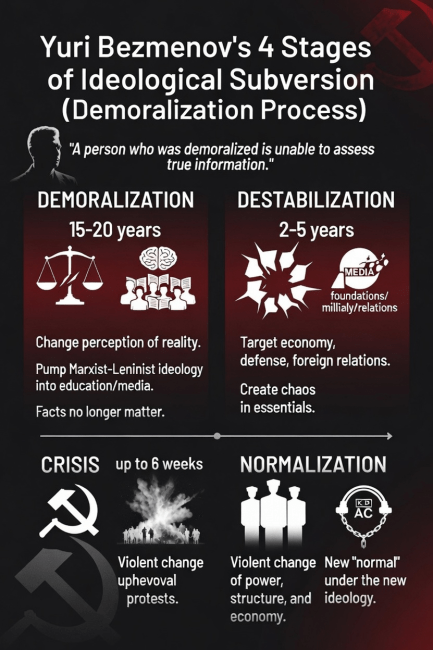
What Bezmenov described at the societal level tracks closely with the techniques used to develop and control an individual asset. In that work you map vulnerabilities, build rapport, introduce gradual compromises, isolate the person from previous supports, create complicity, and finally reshape their sense of reality until loyalty to the handler or the cause feels like the only option. The same sequence can be run at scale. Institutions and cultural pressures can perform the mapping and rapport-building. Social and economic incentives can supply the gradual compromises. Cancellation, shaming, and the threat of lost status can do the isolating. Repeated public signaling and enforced language can manufacture the complicity. Over time the population learns to police itself.
This does not require a single master plan or a secret room full of puppeteers. It can emerge from convergent interests: ideological conviction in some quarters, institutional self-preservation in others, technological amplification of whatever spreads fastest, and the simple fact that fear and status are powerful motivators. The result can look coordinated even when it is not centrally directed. A loyalty test can be built around almost any symbol, a flag, a cause, a shared enemy, and used to declare certain questions off-limits before they are even asked. A charge of extremism, deployed selectively, can foreclose scrutiny of power in one direction, while leaving it wide open in another, regardless of which direction that happens to be at a given moment. Large-scale failures and scandals, whether foreign influence operations, compromised institutions, or unsustainable trajectories left unaddressed, can be observed, discussed, and then set aside because the demoralized response has already been prepared: there is no point in acting, the system is too big, the alternatives are worse, or anyone who presses the issue must be acting in bad faith.
It all begins to resemble a scripted contest in which the outcome is less important than keeping the audience engaged, and the underlying rules unquestioned. The defector who described demoralization, and the intelligence officer who learns how to break an asset through incremental compromise, are describing the same basic technology of control – one applied to populations and the other to individuals. The question of who learned from whom (whether cultural theorists of hegemony influenced operational tradecraft or whether operational experience shaped the theories) is less important than the observable result: a society that can know certain things are badly wrong yet remains largely passive about them.
The deeper difficulty is not simply that the mechanisms exist. It is that many of us find it almost impossible to accept that the same patterns could operate inside the institutions and culture we were raised to trust. We can recognize the logic when it appears in a Romanian prison camp or an insurgent-controlled district. We struggle to see it when the vocabulary is our own and the institutions carrying it claim to be defending the very things the old methods once destroyed. That resistance to recognition is itself part of the pattern. It protects the mechanism by making it nearly unthinkable that “our side” could participate in the same project of breaking loyalties and remaking people for ends that would be obvious if the labels were different.
The Higher Stakes in America
The difference now is the setting. The United States possesses power, technology, and reach that the Communist regimes of the last century could only dream of. If an ideology, built on the same foundations of remaking the person and concentrating all authority, ever consolidated control here, the results would not be limited by poverty or primitive tools. The capacity for surveillance, for narrative control, for the isolation and re-education of dissenters would be vastly greater.
History shows what follows when such systems face no effective internal resistance. The memory of what was done behind the Iron Curtain, and of how easily intellectuals once explained it away, serves as a warning rather than a reassurance. The same spirit that demanded the denial of God, parents, and country in the Romanian camps continues to erode those same anchors wherever it gains influence, regardless of the flag under which it marches.
Looking back across these years, from the boy in southeast Texas who could not understand how people could design the destruction of souls, to the veteran who has carried the cost of confronting evil in the field, to the man who now sees familiar patterns in the behavior of neighbors and fellow citizens, one thing has become clear. The sickness is not new, and it is not merely political. It is an assault on the image of God in the person, on conscience, and on the very anchors that the Pitești prisoners were forced to renounce: faith, family, truth, and freedom.
Genovese’s question to his fellow academics still hangs in the air whenever anyone chooses ideology over the evidence of broken lives. The power of this country makes the stakes higher, not lower. What remains is the steady work of remembering what was done, of refusing to look away when the same spirit appears in new forms, and of holding fast to the things every such system has always sought to break. That remembering is itself an act of resistance and perhaps the beginning of healing for wounds that run far deeper than politics.


[…] How different powers (including the uS military) use familiar patters to engineer people/societies in the form they want them, https://orthodoxreflections.com/from-the-iron-curtain-to-the-present-reflections-on-the-persistence-… […]
Everybody knows what happened in the Soviet Russia during Stain times. There are videos on YouTube under the title – The Gulag. Same for the Pitesti Prison, and that horrible experiment. The result was the dismantling of the system in 1989. The system was economically bankrupt producing mediocre items. This is the result of killing, or at east marginalizing a generation of intelligent people, and replacing them, in any position, with low-IQ, low-life individuals.
It is also known that their faith has helped those in the prisons and gulags to survive. They remembered psalms, and prayers that moms and grandmas taught them. These recent generations have not such shields, and armors. They will be the material in the “Grinding Machine” from “Wish You Were Here” by Pink Floyd.
Important is, in the Western countries as well as US, what the future will bring when it is obvious that an international, and national elites, after some questionable planning, are creating a strange future. For more clarification, on the future socio-economic developments, one can read the book “A brief history of the future” by Jacques Attali. On the same note, I recommend listening to Leonard Cohen in the prophetic-like song “The Future.”
Some really relevant observations here. And, yes, its nothing new, but now the psyops, control measures, and conditioning of the mind are supercharged with technology. During the iron curtain, surveillance was done by family and friends, now, its done by your cell phone, credit card purchases and flock cameras. Living in farm country the issue of data centers taking millions of gallons of water from towns and agriculture is finally meeting some resistance. But, most of the time, the municipal and county authorities are caving to the technocracy that CS Lewis mentions in some of his writings. Its either food, or data centers, both cannot exist on the same water supply. Where is this all going? If our cell phones and computers work fine now, why the big push for data centers. Something is going on there, they are not telling us–but, its the same blue print as before–demoralize, then destabilize.